“Hey Eva! Someone told me my Human Design Environment Variable can tell me how to set up my workspace for maximum productivity. Is that true?”
Well… Kind of.
Your Human Design Environment Variable (sometimes also called “Environment Style”, or simply “Environment”) tells us what kind of physical spaces suit you best.
This information is not just about productivity in the traditional sense, although it can absolutely be used to set up your home office.
It’s about finding the places that support you in becoming the unique, differentiated being you came here to be.
In this article, I’m sharing how to find out what your Environment “style” is, an overview of each of the 6 (but really 12 😉) different Human Design Environments, as well as some tips & tricks for experimenting with your Environment Variable.
What Is The Environment Variable in Human Design?
Your Environment Variable shows us what types of physical spaces are most supportive to our physical “vehicle” (a.k.a. our body).
According to Human Design, being in the right environment will bring you the opportunities you need to live out the authentic storyline of your life. The founder of Human Design even calls it “the bedrock of your material success.”
(Hmm. Does living out your life purpose always result in material success? Leave a comment and let me know what you think.)
The Environment Variable is also a part of a bigger concept in Human Design called “The Four Transformations”, which states that:
- If you eat correctly (Determination Variable), and
- Operate in a beneficial environment (Environment Variable), and
- Allow yourself to see things the way you were meant to (Perspective Variable)
… You will be driven to unlock a unique way of interacting with the world (Motivation Variable), eventually becoming a powerful resource (Outer Authority) for other people to draw on.

So… It sounds like this Environment thing is pretty important, huh? 🤔
How To Find Your Human Design Environment Variable
Since Variables are considered an “advanced”(ish) concept in Human Design, many chart generators don’t include this information in their free reports.
If you want to find out your Human Design Environment “style” for free, I recommend using the Neutrino Design App website.
The free version will give you a chart like this:
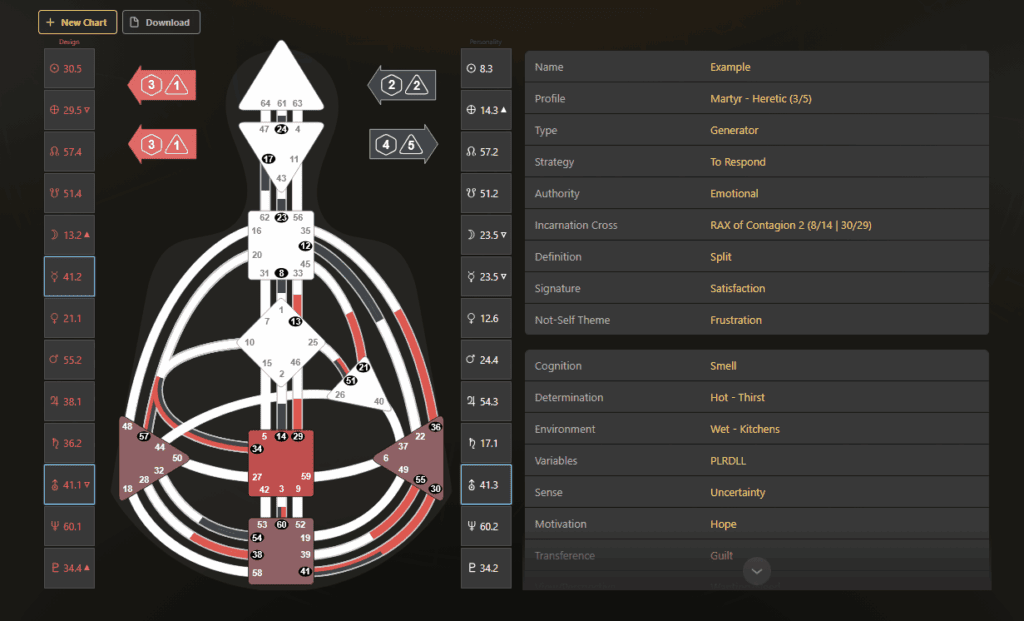
And your Environment information will be listed on the right side like this:

Note: If you enjoy puzzles, you can also figure out this information by Googling the numbers attached to your Design Nodes/your Environment Variable arrow here…
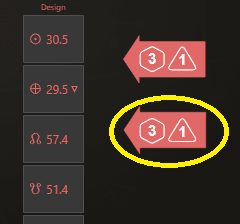
… But I think that’s a bit unnecessary for beginners to get into, and that your time (and brainpower) would be better spent elsewhere for now.
The 6 Human Design Environments
I’ve prepared my own descriptions of the 6 Human Design Environments below.
Each Environment comes with two variations. I would encourage you to read the descriptions for both variations of your main Environment (e.g. Caves) to see the subtle differences between them.
Caves
If you have a Caves Environment in Human Design, feeling safe, secure, and in control of your surroundings is very important to you.
You are not designed for open office environments or “hot desking” (ew 🤮). You need to be able to control who has access to your space. People coming in without knocking, or, God forbid, touching your stuff? Absolutely not.
Rooms with more than one entrance could make you feel uncomfortable and on edge. No matter where you are, try to position yourself so that your back is against the wall + you can clearly see the door.
As children, Caves people tend to be quite fond of building blanket forts or seeking out little hideaways to disappear into. As an adult, taking some time to decompress in your car (with all the doors securely locked) can be a great alternative.
Selective Caves*
As the name suggests, you are meant to be very selective about who comes into your space and when–even more so than your Blending Caves cousins.
You like your things “just so”, and can be quite resistant to any outside influences on your space. If someone brings you a new plant as a housewarming gift, you may find it annoying rather than helpful; you already had your decorations figured out on your own!
If you can’t have your own office, a cozy living room workspace could work well for you. Just make sure to let your family know when not to disturb you.
*Depending on the chart generator you use, Selective Caves are also sometimes called “Exclusive Caves”,
Blending Caves
This is the more “open” variation of the Caves Environment. You still need your own space (an open office will not work for you long-term), but you’re a bit more inclined to leave a door open for other people to come visit.
You work best when you have a way to observe people from where you are sitting: either physically (through a window) or digitally (as a part of your job). Doing some people-watching from your car, with the doors locked, can be a very relaxing experience.
If you can’t have your own office, a small, cozy cafe could do in a pinch; it might just take you a few visits to build up the sense of security you need to feel comfortable there.
Markets
If you have a Markets Environment in Human Design, you thrive in spaces that feature an element of exchange + a wide variety of options for you to choose from.
Options for what? Well, anything and everything, to be honest.
You are built to be very selective and discerning about everything you bring into your life, big or small. For example, if you are going to grab a coffee somewhere, you need at least a few locations to choose from (the more, the better).
Because of this, Markets people will rarely feel comfortable in rural environments; the choices (in terms of food, jobs, or even romantic partners) are simply too limited for them.
Seasonality is another important factor here: you may wish to refresh your space every time a new season rolls around, or when you begin a new chapter in your life.
It’s hard to update your office decor for autumn when the nearest home decor store is 100 kilometers away, you know?
Spending time in a real-life marketplace (e.g., your weekly farmer’s market) could be very supportive for you. However, you can also play with the element of exchange by starting your own business, or even incorporating some digital window-shopping into your evening routine.
Internal Markets
Internal Markets people are ideally suited to starting a home-based business–essentially creating a “marketplace” environment within their current living space.
When in their correct environment, they become more energized and excited to showcase their gifts, which is ideal for marketing, selling, and interacting with clients.
A therapist with an Internal Markets Environment will feel better running an at-home practice than working in a busy clinic; a hairdresser may prefer to see their clients in their living room (à la Portland) instead of renting a “proper” salon space.
External Markets
If you have an External Markets Environment in Human Design, you are designed to find your “marketplace” from home–but perhaps not too far away.
Many people with this Environment style end up running a business (e.g., a hair salon) on the first floor of their house, while setting up their living space right above. Living a few blocks away from your workplace–or another environment where some sort of exchange is occurring–works too.
That way, you are never too far away from where the action is, and can always observe the transactions being made around you.
Kitchens
If you have a Kitchens Environment in Human Design, you are designed for transformative environments where different ingredients come together to create something new.
Rural living is not for you; you are designed for the hustle & bustle of urban environments where something is always being “cooked” (be it a new store, a work project, or a meal at your favorite restaurant).
Nourishment is another important element of the Kitchens Environment.
Does your Environment provide you with the right kind of fuel–physical, emotional, and spiritual–to support your latest experiment? (Where do you keep your snacks?)
When in doubt, go back to your kitchen–literally. Buy yourself some nice kitchen equipment (or upgrade your workshop, if cooking is not your thing). Invite your friends over and have a meal at the kitchen table. Allow yourself to deviate from existing recipes and incorporate new ingredients into your menu.
Wet Kitchens
If you have a Wet Kitchens Environment in Human Design, you are designed to actively participate in the cooking process.
You will feel your best when you’re getting your hands dirty, experimenting with different “spices”, and being in the middle of whatever alchemical magic is happening around you.
In addition to that, humid environments can be very supportive for you. If you live in a dry climate, invest in a humidifier ASAP (and consider booking a trip to Mallorca if budget allows).
Dry Kitchens
If you have a Dry Kitchens Environment in Human Design, you are designed to observe the cooking process from the sidelines.
You will feel your best when standing right on the edge of all hustle & bustle, watching how one thing turns into another and noting down your observations about it.
In addition to that, dry environments suit you better than humid ones. If you live in a humid climate, invest in a dehumidifier ASAP (and consider booking a summer vacation in Greece if budget allows).
Mountains
If you have a Mountains Environment in Human Design, you are designed for spaces that give you a higher vantage point: be it a literal mountaintop or the top floor of a skyscraper.
You need time away from people to “catch your breath” and see the bigger picture; to really look at what’s going on below you. Because of this, regular trips to the mountains can be very healing for you.
However, you can also experiment with this Variable by packing up all your stuff, booking a room at a high-rise hotel, and going on a “work retreat” with your phone set to Do Not Disturb.
There is an interesting link between Mountain people and oxygen deprivation.
If a Mountains person cannot experience the lower oxygen levels found at higher altitudes, they may try to find coping mechanisms that accomplish the same thing, such as smoking or burning copious amounts of incense in their home.
Hobbies like deep sea diving and breathwork are also common, as are bedroom activities involving oxygen deprivation.
Active Mountains
If you have an Active Mountains Environment in Human Design, visiting higher elevations will make you more focused and active.
You may feel like going for a challenging hike or strategizing your next business move while letting the world below you do its thing. You’ll probably feel a bit more connected to the world below you than your observation-oriented Passive Mountains cousins.
(Fun fact: one of my best friends from college has an Active Mountains Environment. Their favorite hobby? Pole dancing. 👀)
Passive Mountains
If you have a Passive Mountains Environment in Human Design, visiting higher elevations will make you more peaceful and relaxed.
Instead of forcing yourself to do something active, you may want to simply observe the world below you without trying to influence it in any way.
Valleys
If you have a Valleys Environment in Human Design, you are designed to thrive in spaces that are close to the ground + connected to the flow of information–just like our first valley settlements used to be.
Seriously, the closer to the ground you can get, the better.
If you live in an apartment, make sure it is on the ground floor. If your bedroom is on the second floor and you’ve caught a cold, move to the living room couch on the first floor while you recover.
And if you feel overstimulated because the world is Just Too Much? Plop yourself down on the floor to regulate your nervous system a bit quicker.
Even though Valleys are sometimes associated with the wide open spaces found in more rural environments, complete isolation is not good for you. You need a way to “keep your ear to the ground” and stay connected to the flow of conversations around you.
When designing your space, pay close attention to the acoustics; what you hear around you will directly affect your well-being.
Narrow Valleys
If you have a Narrow Valleys Environment in Human Design, you are designed to actively engage with the sounds in your environment.
As such, you may prefer more intimate, compact spaces that bring people together and facilitate conversation (e.g., a cute little cafe rather than a huge amphitheater).
Wide Valleys
If you have a Wide Valleys Environment in Human Design, you are designed for wide, open spaces where sound carries easily.
You want to be able to tune into the hum of life around you without listening to anything in particular.
If the farm life is calling to you, great.
Just make sure to visit the local pub regularly so that you can catch up on gossip coming into your Valley.
Shores
If you have a Shores Environment in Human Design, you feel best in places that act like a boundary line between two different environments.
The seashore itself is a great example of this, as it marks the boundary between land and water.
Something in you is fascinated by the things that lie beyond the horizon; sometimes so much so that you trip over your own feet because you keep looking so far ahead.
Having this view of the horizon (or whatever boundary line you’ve chosen for yourself) is important for you. If you can, try to position your desk to face the window, so that you can always look out and dream about things that lie beyond.
The element of water is very important to Shores people. If living on a literal shore of some kind is not in the cards, try experimenting with water-based decorations (e.g., a mini fountain on your desk) or water-based hobbies (e.g., surfing).
Natural Shores
If you have a Natural Shores Environment in Human Design, put that beach trip on the calendar ASAP.
Being out in nature, near a body of water, with lots of things to occupy your mind and body + sunlight shining upon you = your body’s idea of a perfect day.
If a beach is not within reach, look for other naturally occurring boundary lines in your environment. A house on the edge of a cliff, or a restaurant that sits riiiiight on the edge of a forest, might just feel like home, too.
Artificial Shores
If you have an Artificial Shores Environment in Human Design, the boundary lines you seek may be more artificial: like the train tracks separating two parts of a city, or a park that marks the transition to the suburbs.
Being able to observe the way the landscape changes will make you feel more relaxed and at peace.
(You may also prefer artificial lighting over sunlight. Can you please leave a comment if that tracks for you? Inquiring minds want to know.)
Hardscape vs Landscape Environments
The first three Environment types (Caves, Markets, Kitchens) are what the founder of Human Design called “Hardscapes.”
Hardscape people will have an easier time getting environmental needs met in artificially created + somewhat enclosed spaces. Their immediate surroundings are really important to them.
In very simple terms…
Did someone build it? That’s a hardscape.
Are there walls around it? Yep, a hardscape.
Can you see a fence or a roof? Very much a hardscape.
The other three Environments (Mountains, Valleys, Shores) are called “Landscapes.”
Landscape people need a more open environment; something that won’t constrict them like four walls and a roof would. They are also looking beyond their immediate environment (e.g., beyond their office) to get their environmental needs met.
In general, it can be a bit easier to find Hardscape elements in urban environments and Landscape elements in more rural ones.
However, this doesn’t mean that Hardscape people are by definition “indoorsy” or that Landscape people spend all their time traipsing around The Great Outdoors.
A Mountains (Landscape) person could easily thrive on the 25th floor of a NYC skyscraper; similarly, a Caves (Hardscape) person could be perfectly happy building out their “cave” in the middle of the Scottish Highlands.
Observed vs Observer Environments
Your Environment Variable also determines how you are meant to feel when you’re in your correct environment.
We call this being “Observed” versus being the “Observer.”
If the bottom left arrow on your Human Design chart is facing left, you are here to be Observed; if it is facing right, you are here to be the Observer.
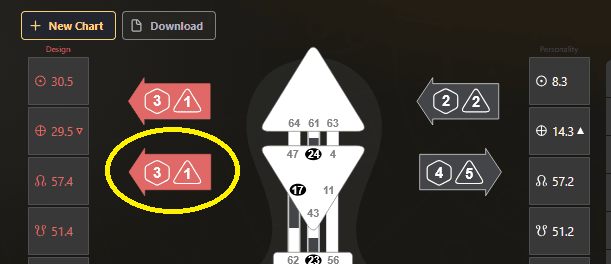
You can also check which one you happen to be by looking at the table below:
| Observed Environments | Observer Environments |
| Selective Caves | Blending Caves |
| Internal Markets | External Markets |
| Wet Kitchens | Dry Kitchens |
| Active Mountains | Passive Mountains |
| Narrow Valleys | Wide Valleys |
| Natural Shores | Artificial Shores |
If you have an Observed Environment style, the right environment will make you feel active and energized. You will want to showcase your gifts and talents for other people to observe (hence the name “Observed”).
If you find yourself feeling sluggish, sleepy, or bored in your current environment, consider moving to a different space.
If you have an Observer Environment style, the right environment will make you feel relaxed and at peace. You will want to observe the people + happenings around you (hence the name “Observer”).
If you find yourself feeling agitated or nervous instead, consider moving to a different space.
How To Use Your Human Design Environment Variable In Real Life
According to one school of thought, you may not have to do anything specific to find your right Environment.
Instead, you can let your awareness of this information filter things for you, eventually guiding you to a place that’s correct for you.
(Eating according to your Determination Variable can aid you in this quest by making your brain sharper and more susceptible to what’s correct for you.)
Me, however? I think we all have a bit too much conditioning going on to leave it entirely to chance.
(Or perhaps that’s my own conditioning speaking? Hmm.)
Okay, fine. FINE. I’ll admit it.
I just think it’s really fun to play with this Variable, alright? 😀
You can do so by:
- Taking a trip somewhere that fits your Environment type (e.g. going to a beautiful beach house showing as a Natural Shores person)
- Incorporating elements of your Environment type into your existing workspace (e.g. moving your desk to face the exit if you are a Caves person)
- Figuring out what public places already have elements of your Environment type (e.g. a Kitchens person might feel great at a busy cafe)
… And then seeing how you feel.
Does your perception of the world change when you are in these spaces? Do you feel more like yourself when you are at the beach versus at the top of a mountain?
Finally, your Environment Variable can be a fantastic way to determine which opportunities will be right for you.
For example, if a Caves person is offered two job opportunities and is struggling to hear their intuition (or their Strategy & Authority), they can compare the two office environments to see which one has more of a Caves vibe.
My Experience With My Human Design Environment Variable
Me? I am an Internal Markets person.
In some ways, I’ve been in my “ideal” environment ever since I quit my (first and only) corporate job at the grand old age of 22 and proceeded to build a freelance writing business from the comfort of my home.
It’s been great. Truly.
However, that’s just one dimension of the Internal Markets environment.
Having access to a variety of options is very important for Markets people–something I’ve kind of struggled with while living in my (gorgeous, amazing, gift from the gods) small-town apartment.
There’s only one coffee shop, one tiiiiiiny farmer’s market stand, and, like, two decent places to go if you’re in the mood for a dinner out.
I try to supplement this by:
- Taking a daily walk around the shops that we do have (instead of buying groceries for the entire week ahead)
- Planning regular-ish trips into the big city (just to meander around & see what’s new) (← I need to be better at this!!)
- Doing some digital “window shopping” whenever I get a chance (thankfully my screen blocking app doesn’t block Vinted)
- Putting on a YouTube ambience video that showcases a Markets Environment while I work (lmk if you want recs)
- Re-organizing our home office whenever things get stale (my husband is a very patient man)
- Going all out on seasonal Pinterest moodboards (yes, I am that girl)
+ Realizing that I’m meant to be active in my environment (Observed Environment Style) has really helped me decondition from other people’s ideas about what my workdays should look like.
As much as I love the idea of the #softgirllife… I feel my best when I’m active, busy, and Doing All The Things (within reason, of course).
What if I don’t resonate with my Human Design Environment Variable?
Could be a few things, honestly.
Your Digestion/Determination
If you don’t resonate with your Environment Variable, my first question would be… What’s your relationship to your Determination/Digestion Variable?
Are you nourishing your brain correctly, so that it can easily point you in the right direction?
After all, your Environment Variable is the second Transformation in The Four Transformations in Human Design.
Have you engaged with the first one yet?
Your age
My second question would be… Are you 30 yet?
Our Saturn Return, which happens around the age of 30, has a tendency to set us on the correct path (even if it has to drag us there kicking and screaming).
(This is extra important if you have a 6th line in your Human Design Profile. Your 20s tend to come with an extra helping of trial & error that will naturally sort itself out later in life. 😉)
Your birth time
And my third question would be… Are you *absolutely* sure about your birth time?
A few minutes could easily change your Environment from Internal Markets to Blending Caves, resulting in a completely different set of environmental recommendations.
Your chart configuration
Humans can be full of contradictions–and so can our Human Design charts.
Perhaps there’s something else in your chart that’s making the Variable information feel “stickier” than normal?
One example of this would be a lot of Left-pointing Variable arrows in a person with 7 Undefined Centers. How the heck are you supposed to be active & strategic when your sensitivity levels are completely off the charts?
^^ If you think that might be the case, I’d love to explore all the beautiful contradictions & connections of your chart during a Human Design Reading.
Human Design Environment FAQ
Where can I find out what Environment I’m meant to be in? My chart generator does not have this information.
The Neutrino Design App website will give you all your Variable information for free, including your Environment info.
Where does the Environment Variable information come from? How is it calculated?
Your Environment Variable is determined by your South Node & North Node placements on the Unconscious (Design) side of your Human Design Chart.
Where can I learn more about my Human Design Environment?
If you want to take a deeper look at the Variables, including your Environment, you will want to look into resources related to PHS (Primary Health System).
Is all of this Environment info Ra-approved?
Hmm. Maybe? While 80% of the Human Design knowledge in my brain comes from Ra-approved sources (Jovian Archive and IHDS), I’m also at a place where I want to share some of my own conclusions about these things.
If a concept or an idea is not resonating with you, you can always ask me “where I got it”, so to speak.
Resources & Links
If you are a more advanced student of Human Design (and don’t mind slogging through some Ra-speak), the PHS External Color Book from IHDS offers a good overview of all six Environments.
If you’d like some more specific tips on making your current Environment feel like home, Vaness Henry has some wonderful (and free!) blog posts on this topic.
You Don’t Have to Be Perfect
The founder of Human Design is not coming to whack you on the head if you don’t immediately sell your house and move to a remote beach somewhere.
(The dude, bless his heart, is already six feet under. The world is our oyster now.)
So don’t let perfectionism get in your way.
A few small changes (like shifting your chair to face the door if you are a Caves person) can make a big difference in how you feel in your space. ❤️
An Invitation to Respond To–In Your Own Time
If you’d like to discover more magical parts of your chart–and perhaps get some more specific suggestions for making your space feel like yours–consider this your invitation to book a Human Design reading with me.
Even though my knowledge of Human Design is based on what I would consider “source material”, my approach to readings is nuanced, non-dogmatic, and experimental.
I don’t subscribe to the idea that Human Design has to be “all or nothing”, or that we *need* to do something just because the founder of Human Design said so.
If that’s your vibe…